Claude reconstructs the origin of five key numbers in cryptography after decades of mystery
Anthropic publishes a reproducible solution to the riddle of the seeds for five NIST curves. The verification clarifies where they came from and allows a long-standing controversy over trust in cryptographic standards to be revisited.
What has been announced
Anthropic announced on October 16 that an internal research model of Claude had determined how five values used to construct standardized cryptographic curves more than a quarter of a century ago were generated. According to the company, the system found the explanation in less than half an hour: a pseudorandom number generator initialized with dates from 1997 and 1998.[1]
The finding concerns the so-called seeds for P-192, P-224, P-256, P-384, and P-521, published by the United States National Institute of Standards and Technology, NIST, in the FIPS 186-2 digital signature standard in 2000. They are public parameters used to derive part of the mathematical description of those curves. They are neither passwords nor users' private keys.[2]
The lingering question was where they had come from. In 2023, cryptographer Filippo Valsorda organized a bounty to find out. One explanation circulating at the time pointed to phrases transformed through a hash function. Knowing the actual procedure would make it possible to examine more closely how much leeway existed in choosing the values, an issue that had fueled suspicions of possible manipulation.[3]
An explanation that can be verified
The research identified the footprint of lrand48, a common generator in older C programming libraries. Working from the published values, Claude reconstructed internal states and initialization timestamps compatible with Unix clocks. Anthropic has released a program that reproduces the seeds, meaning the conclusion can be subjected to direct verification.[1]
Valsorda confirmed on October 16 that the team had claimed the bounty the previous day and that he had reimplemented the procedure in the Go programming language to verify it. The researchers chose to donate the prize to the Internet Security Research Group, the organization behind Let's Encrypt. That choice brings the bounty total to $36,864, in accordance with the contest rules.[4]
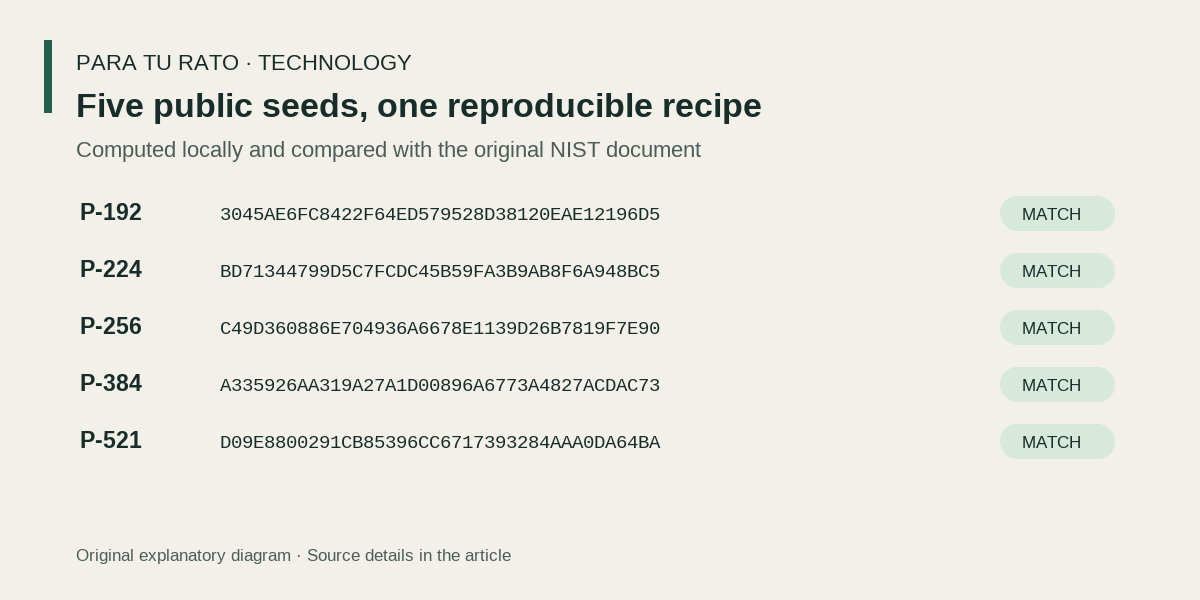
For this article, an implementation of the calculation was also executed and its results were compared against the five values in the original NIST document. All five match. The check confirms that the recipe reproduces the public numbers; its scope is limited to that mathematical correspondence.[2]
What changes for security
A digital signature makes it possible to verify the origin and integrity of a message. Its security does not depend on keeping the public parameters of the curve secret. For that reason, discovering how those seeds were chosen is distinct from obtaining the keys of those who use the system. The news provides insight into how the standard was designed, without describing a way to forge signatures.[2]
Valsorda considers that the result strengthens confidence in the curves and narrows the selection margin that underpinned certain manipulation hypotheses. He also acknowledges that apparently valid candidates remain that were discarded for reasons still unknown. The historical trail can be reconstructed with greater precision, even though it does not preserve every decision made by its authors.[4]
Anthropic points to other unknowns: it has not explained the B-163 seed or the origin of several base points. The duration of the discovery and the role played by the model come from the company's own account; reproducing the seeds does not independently verify that working time.[1]
The case offers a concrete way to evaluate an AI contribution to research: a finding that ends in a public calculation, testable against a document that predates the model itself. Its scientific interest lies in that capacity for verification and in the well-defined questions it leaves open.
Sources and checks
Company documentation details announcements and specifications, while reports, analyses, and user accounts provide external context. Multiple pages from one company do not represent independent verification, and external links do not constitute editorial endorsement.
- [1] Anthropic — Claude reveals ECDSA curve originsOfficial source · Checked on 17 October 2026
- [2] NIST — FIPS 186-2 Digital Signature Standard, documento históricoDocumentation · Checked on 17 October 2026
- [3] Filippo Valsorda — Announcing the NIST Elliptic Curves Seeds BountyDocumentation · Checked on 17 October 2026
- [4] Filippo Valsorda — The NIST Elliptic Curves Seeds Bounty Has Been ClaimedDocumentation · Checked on 17 October 2026