Gemini 4 Argon wants to take your ideas beyond chat
Google is expanding access to its new model. Amid the promises, early tests and subscription plans, there is an important distinction between chatting and coding with it.
The change worth following
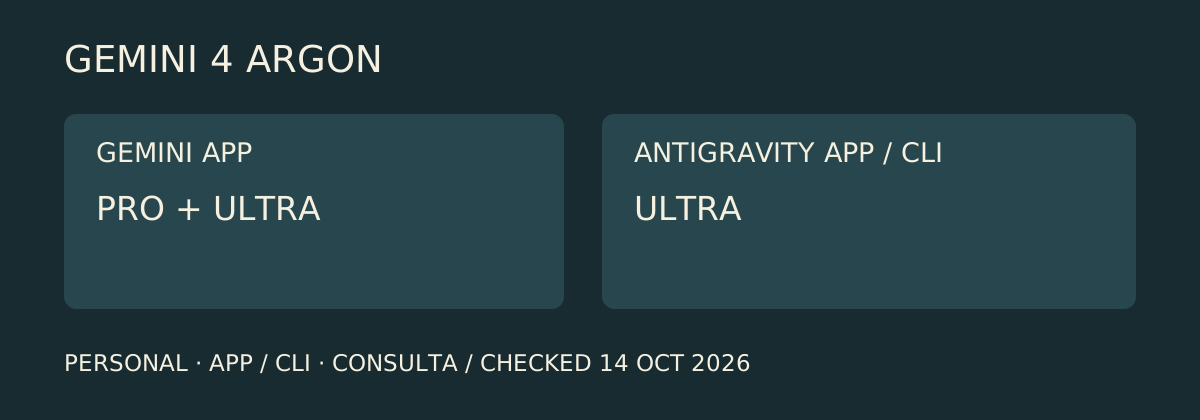
Google began rolling Gemini 4 Argon out to Pro and Ultra subscribers in the Gemini app on 13 October. The intriguing part is its ambition: moving from answering a question to helping carry a complicated piece of work through. If you have ever ended an AI conversation thinking “fine, but now I have to do it myself”, you can see why that idea is appealing. Access also depends on the tool: having Pro in Gemini does not unlock Argon in Antigravity. Think of an idea you have left unfinished: a small website, a simple game or a presentation whose notes are scattered everywhere. The hard part may be joining the pieces, staying on course and fixing what breaks along the way. That is where a tool like this becomes interesting. It makes sense to judge it by the project it helps complete and the corrections it needs, rather than how convincingly it describes its plan.[2][11][1]
Google began rolling Gemini 4 Argon out to Pro and Ultra subscribers in the Gemini app on 13 October. The intriguing part is its ambition: moving from answering a question to helping carry a complicated piece of work through. If you have ever ended an AI conversation thinking “fine, but now I have to do it myself”, you can see why that idea is appealing. Access also depends on the tool: having Pro in Gemini does not unlock Argon in Antigravity.[2][11]
Think of an idea you have left unfinished: a small website, a simple game or a presentation whose notes are scattered everywhere. The hard part may be joining the pieces, staying on course and fixing what breaks along the way. That is where a tool like this becomes interesting. It makes sense to judge it by the project it helps complete and the corrections it needs, rather than how convincingly it describes its plan.[1]
What Google promises, and what it means
Google presents Argon as a model for complex, multi-step tasks. Its demonstrations include 3D visualizations and games, while the company describes internal code-refactoring work. It is an appealing direction: asking for something that must function, rather than merely receiving an explanation. These are Google’s examples and claims; the announcement does not establish what everyone will get from a similar request. To understand the distinction, imagine wanting to build a minigame with a finish line and a score. Drawing an attractive screen would only be the start. You would then need to check that it is playable, its controls respond and a bug does not lose the score. That would be a useful test to set it: divide the idea into observable requirements and see what actually works. The excitement lies in exploring that possibility without calling the job finished because the first image looks impressive.[1]
Google presents Argon as a model for complex, multi-step tasks. Its demonstrations include 3D visualizations and games, while the company describes internal code-refactoring work. It is an appealing direction: asking for something that must function, rather than merely receiving an explanation. These are Google’s examples and claims; the announcement does not establish what everyone will get from a similar request.[1]
To understand the distinction, imagine wanting to build a minigame with a finish line and a score. Drawing an attractive screen would only be the start. You would then need to check that it is playable, its controls respond and a bug does not lose the score. That would be a useful test to set it: divide the idea into observable requirements and see what actually works. The excitement lies in exploring that possibility without calling the job finished because the first image looks impressive.[1]
A strong ranking does not answer everything
The Vals card we checked places Argon first among 48 models on its Vals Index, at 68.90%. On Terminal-Bench 4.0 it ranks sixth among 48. These are Vals’s own evaluations, external to Google, measuring different tasks. The contrast matters more than turning first place into “it is the best”: the result depends on the work being tested. It does not mean it will answer that percentage of every question you type into Gemini correctly. If you want to prepare a presentation, a ranking focused on other work will not settle your question. For a programming project, you would want to examine failures, tests and how easy the result is to fix. Scores can offer a clue about what to explore, but the useful question remains specific: does it help with the thing that previously left you stuck? Answering that is more valuable than choosing a universal winner for every task.[5]
The Vals card we checked places Argon first among 48 models on its Vals Index, at 68.90%. On Terminal-Bench 4.0 it ranks sixth among 48. These are Vals’s own evaluations, external to Google, measuring different tasks. The contrast matters more than turning first place into “it is the best”: the result depends on the work being tested. It does not mean it will answer that percentage of every question you type into Gemini correctly.[5]
If you want to prepare a presentation, a ranking focused on other work will not settle your question. For a programming project, you would want to examine failures, tests and how easy the result is to fix. Scores can offer a clue about what to explore, but the useful question remains specific: does it help with the thing that previously left you stuck? Answering that is more valuable than choosing a universal winner for every task.[5]
Early tests bring strengths and weaknesses
On 14 October, Ramanpal Singh published his own five-application test on Promptslove. He awarded a racing game and a black-hole simulator five out of five, but gave two to a perfume website and a harbour-town builder. His total was 17 out of 25. That is one author’s experience with those requests, not a user average or proof that Argon excels at every game and fails at every website. That uneven result poses an interesting question for anyone experimenting: which part of the project works, and which needs attention? A result can impress you with its idea and disappoint you in use. Before trusting it with a long task, you can begin with a small one you know how to assess. It need not become an impossible examination: a clear goal, simple criteria and a second look at the output are enough. Curiosity can then lead somewhere more useful than a collection of spectacular screenshots.[6]
On 14 October, Ramanpal Singh published his own five-application test on Promptslove. He awarded a racing game and a black-hole simulator five out of five, but gave two to a perfume website and a harbour-town builder. His total was 17 out of 25. That is one author’s experience with those requests, not a user average or proof that Argon excels at every game and fails at every website.[6]
That uneven result poses an interesting question for anyone experimenting: which part of the project works, and which needs attention? A result can impress you with its idea and disappoint you in use. Before trusting it with a long task, you can begin with a small one you know how to assess. It need not become an impossible examination: a clear goal, simple criteria and a second look at the output are enough. Curiosity can then lead somewhere more useful than a collection of spectacular screenshots.[6]
Access changes with the tool you want to use
The Gemini app includes it with Pro and Ultra. In Antigravity, Argon is restricted to Ultra or eligible Enterprise plans: Pro does not include it. It is also absent from the standalone IDE; Google offers it in the Antigravity app, CLI and editor extensions. A subscription and a model may share a name without granting the same access in every tool. The plans pages checked for Spain, Germany, the United Kingdom and India include Argon in the Gemini app with Pro. The official sources reviewed do not support a blanket exclusion of Europe or an exception granting Pro users Argon in Antigravity because they are in the United States. The announced roll-out does not establish simultaneous access for every account either. An absent model in your selector can raise an availability question; interpreting it requires checking the service and plan as well as the region.[2][11][4][9][7][8]
The Gemini app includes it with Pro and Ultra. In Antigravity, Argon is restricted to Ultra or eligible Enterprise plans: Pro does not include it. It is also absent from the standalone IDE; Google offers it in the Antigravity app, CLI and editor extensions. A subscription and a model may share a name without granting the same access in every tool.[2][11]
The plans pages checked for Spain, Germany, the United Kingdom and India include Argon in the Gemini app with Pro. The official sources reviewed do not support a blanket exclusion of Europe or an exception granting Pro users Argon in Antigravity because they are in the United States. The announced roll-out does not establish simultaneous access for every account either. An absent model in your selector can raise an availability question; interpreting it requires checking the service and plan as well as the region.[4][9][7][8][11]
Regional prices
Spain: Pro: EUR 21.99/month; Ultra: EUR 99.99 or 219.99/month. Germany: Pro: EUR 21.99/month; Ultra: EUR 99.99 or 219.99/month. United Kingdom: Pro: GBP 18.99/month; Ultra: GBP 79.99 or 189.99/month. United States: Pro: USD 19.99/month; Ultra: USD 99.99 or 199.99/month. India: Pro: INR 1,950/month; Ultra: INR 6,500 or 19,500/month. These are the monthly amounts published on 14 October in their local currencies, without conversion. Ultra lists two tiers. These examples are not a single price for Europe, the Americas or Asia; check the country and the conditions applicable to the account.[4][9][7][10][8]
Spain: Pro: EUR 21.99/month; Ultra: EUR 99.99 or 219.99/month.[4]
Germany: Pro: EUR 21.99/month; Ultra: EUR 99.99 or 219.99/month.[9]
United Kingdom: Pro: GBP 18.99/month; Ultra: GBP 79.99 or 189.99/month.[7]
United States: Pro: USD 19.99/month; Ultra: USD 99.99 or 199.99/month.[10]
India: Pro: INR 1,950/month; Ultra: INR 6,500 or 19,500/month.[8]
These are the monthly amounts published on 14 October in their local currencies, without conversion. Ultra lists two tiers. These examples are not a single price for Europe, the Americas or Asia; check the country and the conditions applicable to the account.[4]
What still has no date
Will Argon reach Pro in Antigravity? The announcements and official matrix checked give no confirmed date for that opening. Google talks about future models for a broader range of builders, but that statement does not promise to unlock Argon for Pro. Those are different things: we can follow developments without treating a broad intention as a timetable the company has not published.[3][11]
Will Argon reach Pro in Antigravity? The announcements and official matrix checked give no confirmed date for that opening. Google talks about future models for a broader range of builders, but that statement does not promise to unlock Argon for Pro. Those are different things: we can follow developments without treating a broad intention as a timetable the company has not published.[3][11]
The question that remains after the launch
Gemini 4 Argon has reasons to attract interest: a more ambitious approach to work, external results worth examining and early experiences containing both successes and setbacks. The exciting possibility is that an unfinished idea might finally move forward. Keep that curiosity and set it a demanding but specific task to assess its value. When the project works, you can identify where it helped; when it fails, you can explain what is missing. That conversation matters more than the new number in its name.[1][5][6]
Gemini 4 Argon has reasons to attract interest: a more ambitious approach to work, external results worth examining and early experiences containing both successes and setbacks. The exciting possibility is that an unfinished idea might finally move forward. Keep that curiosity and set it a demanding but specific task to assess its value. When the project works, you can identify where it helped; when it fails, you can explain what is missing. That conversation matters more than the new number in its name.[1][5][6]
Sources and checks · 11
Links point to sources. They are not endorsements or sponsorships.
- [1] Google · anuncio de acceso general, 13 octubreofficial · Checked on 14 October 2026
- [2] Gemini · notas de versión, 13 octubreofficial · Checked on 14 October 2026
- [3] Antigravity · acceso de Argon, 13 octubreDeveloper · Checked on 14 October 2026
- [4] Gemini España · precios consultados el 14 octubreofficial · Checked on 14 October 2026
- [5] Vals AI · evaluación propia de Argonoriginal_testing · Checked on 14 October 2026
- [6] Ramanpal Singh · cinco aplicaciones, 14 octubreoriginal_testing · Checked on 14 October 2026
- [7] Gemini · planes de Reino Unido consultados14Octofficial · Checked on 14 October 2026
- [8] Gemini · planes de India consultados14Octofficial · Checked on 14 October 2026
- [9] Gemini · planes de Alemania consultados14Octofficial · Checked on 14 October 2026
- [10] Gemini · planes de Estados Unidos consultados14Octofficial · Checked on 14 October 2026
- [11] Antigravity · matriz oficial de modelos y planesdocumentation · Checked on 14 October 2026
Was this article useful?
How ratings work
Rate how clear and useful the explanation is, not the product or whether you agree with the news.
Public voting is currently unavailable. A verified shared voting service is in preparation.
Privacy