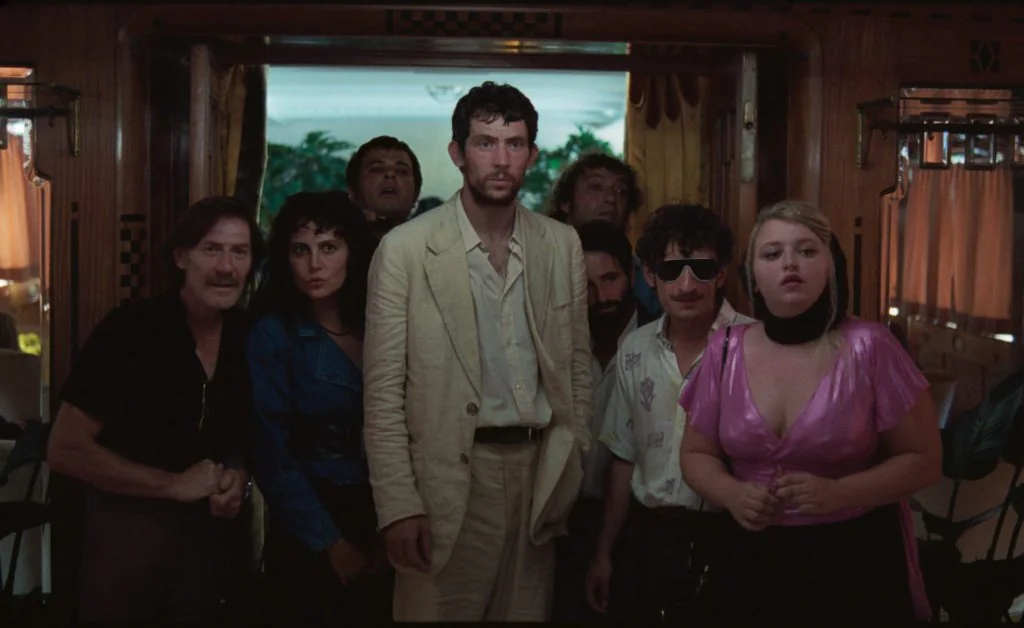
La chimera: the tomb robber searching for the woman he lost
For some, buried objects have a price. For Arthur, the search is bound up with the memory of Beniamina.
They dig for money; he digs for Beniamina
Arthur joins tomb robbers who dream of getting rich. He is searching for Beniamina, the woman he lost: that is the distinction coproducer AMKA draws in its introduction to Alice Rohrwacher’s La chimera.[1]
The Cannes Film Festival’s introduction adds his gift: sensing empty spaces beneath his feet. Played by Josh O’Connor, Arthur has an ability useful to people hoping to sell what they find.[2]
The premise has something of an adventure and a folktale: several people can dig in the same place without looking for the same thing. That gap lets you follow an object’s discovery while asking what each person hopes to recover. The earth offers something to touch; Arthur’s loss raises the question of what cannot be kept in a pocket.
When the sacred gets a price tag
Rohrwacher told Benoit Pavan in the Cannes interview that she grew up hearing stories of discoveries and night digging. She was interested in when an object stops being sacred to one generation and becomes a remnant of the past.[2]
In Filmmaker, she explained the next step to Elissa Suh: sacred objects become commodities that can be bought and sold.[3]
An ordinary cup can be worth little in a secondhand store and be irreplaceable to a family. It is a comparison: price lets objects change hands, while memory ties them to a particular person. In Arthur’s premise, discovering something valuable and finding what is missing are desires that can take different paths.
The director gave Suh a tangible detail of that search: Arthur’s pale suit evokes marble and a bridegroom. It gathers dirt. His silence, she explained, comes from being absent, as though he does not quite know where he is.[3]

A light that moves with the searcher
Cinematographer Hélène Louvart told British Cinematographer’s Robert Shepherd that she preserved the darkness of interiors, especially in winter. In the underground scenes, actors held lights, tying illumination to action.[4]
That method offers a way to understand the search without a technical lecture: the hand moving the light also decides where to look. Attention has a direction and a reach. Connecting the act of searching with what becomes visible makes a story about someone preoccupied with what is absent tangible.
Writing in Time Out, Sophie Monks Kaufman praises O’Connor and highlights the contrast between his emotional distance and a world of communal parties and escapes from the police. Her reading helps place the tone: there is bustle around that loss, too.[5]
There remains the suit Rohrwacher describes: its pale fabric carries the earth of the journey. You can shake the dust from a jacket. Knowing what to do with someone’s memory is a much harder question to settle.
Sources and checks
Company documentation details announcements and specifications, while reports, analyses, and user accounts provide external context. Multiple pages from one company do not represent independent verification, and external links do not constitute editorial endorsement.
- [1] AMKA: presentación y dossier de La chimeraOfficial source · Checked on 23 October 2026
The coproducer’s premise.
- [2] Festival de Cannes: entrevista de Benoit PavanDirect interview · Checked on 23 October 2026
Pavan interviews Rohrwacher (2023).
- [3] Filmmaker: entrevista a Alice RohrwacherDirect interview · Checked on 23 October 2026
Suh interviews Rohrwacher (2024).
- [4] British Cinematographer: Hélène LouvartDirect interview · Checked on 23 October 2026
Shepherd interviews Louvart.
- [5] Time Out: Sophie Monks KaufmanReview · Checked on 23 October 2026
Monks Kaufman’s review (2023).