How to read Steam’s 90% positive rating
The number offers a starting point. Reviewers’ reasons help you choose.
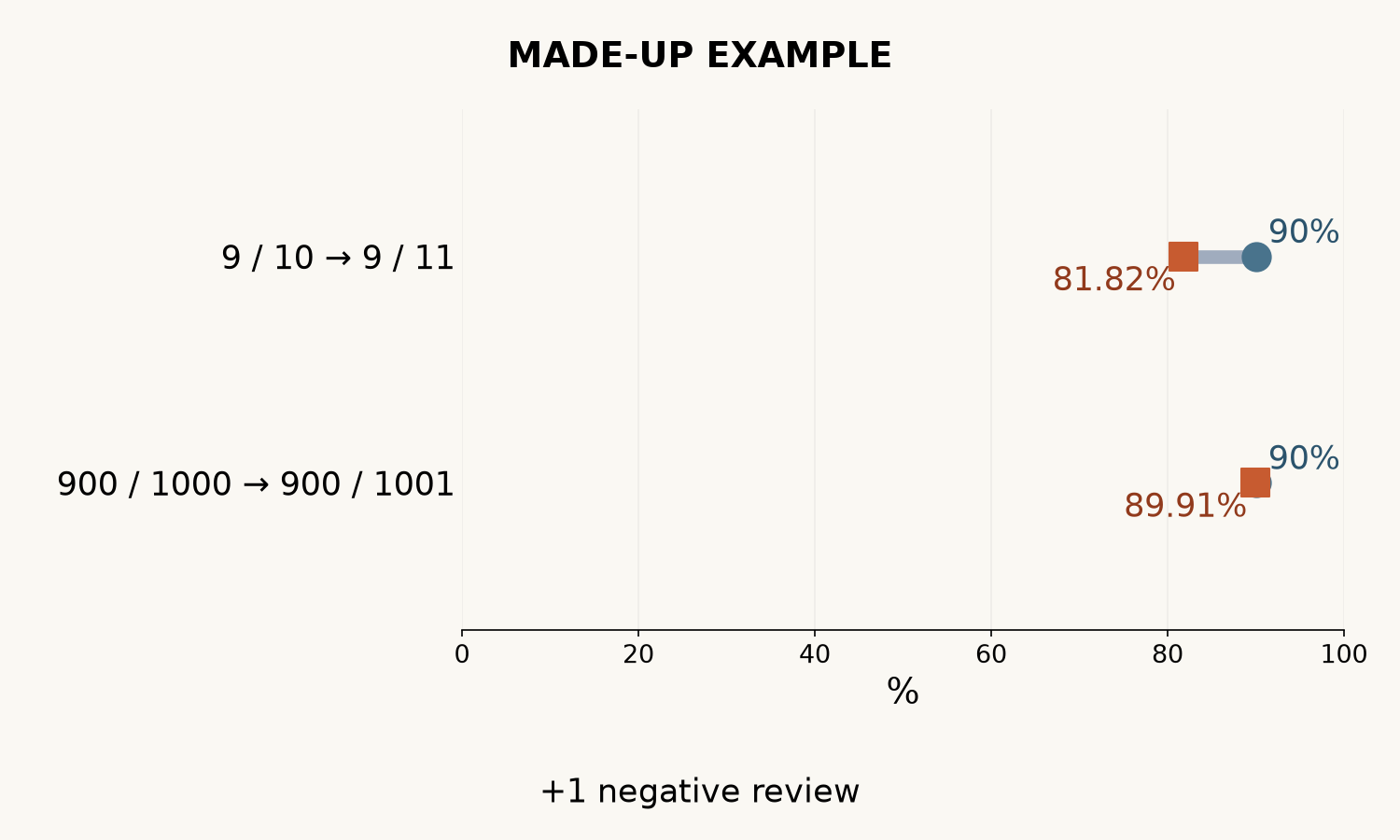
The same percentage, two different stories
A 90% positive rating on Steam tells you what proportion of included reviews recommend the game. It is not an average of numerical scores.[1]
Someone recommending a game with reservations and someone calling it their favorite can end up on the same side of the count. The percentage gives you somewhere to start; opening the reviews reveals how those experiences differ.
Take two made-up games. Game A has nine positive reviews out of ten. Game B has 900 out of 1,000. Both are at 90%. Each receives one additional negative review: A becomes nine out of eleven, or 81.82%; B becomes 900 out of 1,001, or 89.91%. The first loses more than eight percentage points; the second, less than a tenth. These are calculations for the example, rather than real game statistics or a reproduction of Steam’s rounding.
In that calculation, a new opinion shifts the smaller group much further. The drop does not require the game to have gotten worse: we have added one unhappy person. Volume puts the movement in context, although it cannot by itself establish that reviews are honest, represent every buyer or match your tastes.
Check what is being counted before comparing
Valve separates reviews from the last 30 days from the lifetime total. For paid games, external keys allow reviews but do not count toward the Steam-purchase percentage.[1]
If a recent rating differs from the historical one, the next question is what those reviews say. A patch can give you a lead when looking for changes; the difference between percentages does not identify its cause. The version someone describes matters, too.
Following Valve’s August 18, 2025 announcement, some games show a language-specific rating when enough reviews are available. Preferences let you return to the all-language total.[2]
Two friends may see different percentages for the same game. Language does not identify the author’s country or guarantee shared servers. It lets you find comments about a translation.[2]
Recording the percentage, count, period and language when citing a rating makes it understandable later. That tells you more than saving a green label alone: it identifies which group of reviews you were reading.
A positive review can put you off, too
Picture these two opinions, invented for the example: one person recommends a game for its very long dialogue scenes; another rejects it because it felt slow. Both point to a similar feature. If you want immediate action, the first person’s enthusiasm may offer the clearer warning about what you do not want to play.
The useful details depend on the session you have in mind. For a laptop, look for a specific account of problems and the hardware used. For controller play, what someone says about the controls. For a narrative adventure, what kept them reading. A recommendation becomes tangible when it explains its reason.
The date and playtime offer context rather than certifying an experience. Forty hours do not establish that someone finished the game or knows every system. Nor is an old complaint resolved merely because time has passed: you need to check what changed. An angry opinion alone does not identify a bot, either.
After looking at the number, return to what you wanted for tonight. If you want a story to get lost in, that review impatient with all the dialogue may have found exactly your next game.
Sources and checks
Company documentation details announcements and specifications, while reports, analyses, and user accounts provide external context. Multiple pages from one company do not represent independent verification, and external links do not constitute editorial endorsement.
- [1] Valve: cómo se muestran y cuentan las reseñas de SteamDocumentation · Checked on 24 October 2026
Valve: recommendations, periods and external keys.
- [2] Valve: valoraciones por idioma, anuncio del 18 de agosto de 2025Official source · Checked on 24 October 2026
Valve’s August 2025 announcement on languages.