Liquid AI launches a model to run agents on local computers and reduce cloud dependence
LFM2.5-24B-A2B uses only a fraction of its parameters at each step and supports Spanish. Its benchmarks show advantages in certain tool-use tasks alongside limits in knowledge, coding, and memory.
What has been announced
On October 13, Liquid AI unveiled LFM2.5-24B-A2B, an artificial intelligence model designed to power agents running on a user's computer. The company has released both a base version and a version tuned for planning and tool use. The release incorporates a larger context window than its predecessor and training within agent environments, with the aim of improving performance on multi-step tasks.[1]
The model supports Spanish among its 16 documented languages and can handle up to 131,072 tokens of context. This makes it possible to include long conversations and extensive documents in a single session, although maximum window size does not by itself prove that the system accurately interprets all the content. It can already be run with local tools such as llama.cpp and MLX, as well as server engines for deployment on other machines.[3]
Less computation does not mean fewer weights
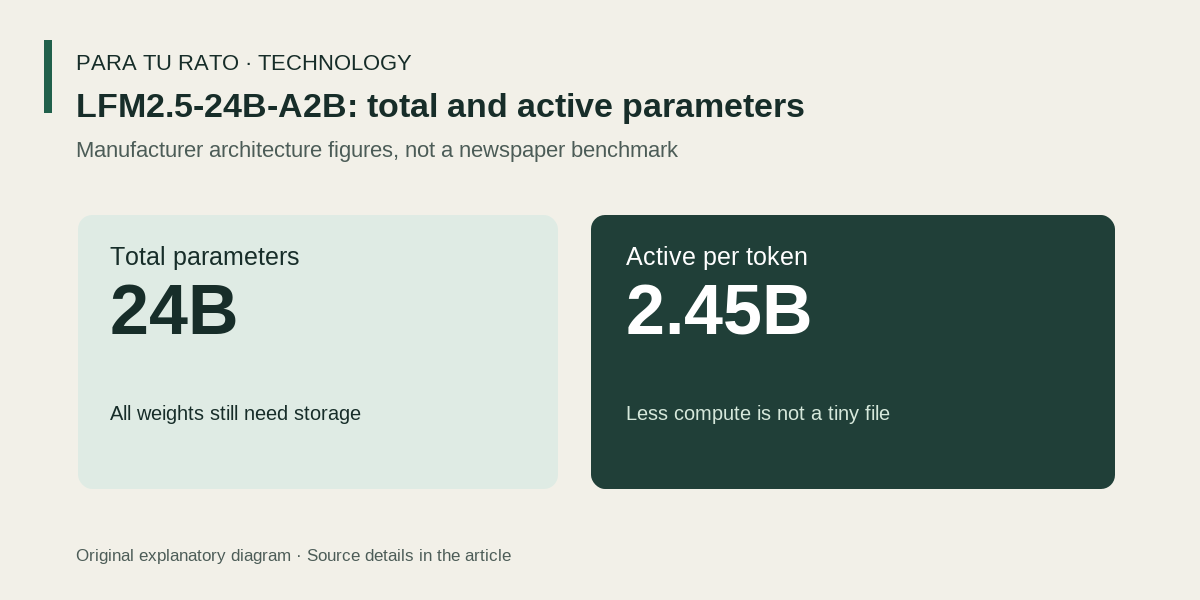
Its architecture brings together 24 billion parameters, but activates 2.45 billion per token. The commercial figure of "2B active" parameters is therefore a rounding. The system selects a portion of the model for each step, which reduces the required computation. It is a model that receives and produces text: the image or audio capabilities of other members of the family should not be attributed to it.[2]
The difference between total and active parameters matters when choosing hardware. The official distribution in Q4_K_M format takes up roughly 14.5 GB, while the BF16 version reaches 48 GB. Those figures correspond to the weights alone, and memory for context and calculations must be added on top. Having only a fraction of the model active does not mean it can be installed as a tiny file or that it will perform the same way on any laptop.[4]
Gains in some tasks and trade-offs in others
The evaluations published by Liquid paint an uneven performance picture. On the LiveClaw agent benchmark, it scores 48.09 points, compared with 38.19 for Qwen3.6-35B-A3B. On SWE-Bench Verified, which measures software problem resolution, it posts 51 versus 66.20 with the OpenCode agent. These are manufacturer measurements. The figures do not support a claim of general superiority, nor do they constitute a specific evaluation in Spanish.[2]
Liquid recommends pairing it with search or document retrieval for work that depends on extensive knowledge. That recommendation defines the intended scope: using the model to coordinate actions and consult available information, without assuming that it holds all the answers on its own. The announcement also explains that its context window grows from the previous model's 32,768 tokens to 131,072.[1]
Local control comes with its own responsibilities
The official guide makes it possible to connect the model to agents such as Hermes, OpenClaw, and Pi through a local server. Response generation can thus take place within the machine. However, if the agent uses tools that contact external services, that part of the work can leave the computer. Running the model locally does not, by itself, describe the entire path that data takes.[5]
The weights are distributed under the LFM license, which is based on Apache 2.0 but includes its own commercial restrictions. Companies that reach or exceed its revenue threshold, set at $10 million per year, need a separate agreement for commercial use. For anyone weighing this alternative, the next step will be testing real tasks, memory usage, and reliability: being able to download a model expands the options, but it does not eliminate the work of getting it up and running.[6]
Sources and checks
Company documentation details announcements and specifications, while reports, analyses, and user accounts provide external context. Multiple pages from one company do not represent independent verification, and external links do not constitute editorial endorsement.
- [1] Liquid AI: LFM2.5-24B-A2B: Built for Fast On-Device AgentsOfficial source · Checked on 17 October 2026
- [2] Liquid AI: ficha oficial LFM2.5-24B-A2BDocumentation · Checked on 17 October 2026
- [3] Liquid Docs: LFM2.5-24B-A2BDocumentation · Checked on 17 October 2026
- [4] Liquid AI: distribución oficial LFM2.5-24B-A2B-GGUFDocumentation · Checked on 17 October 2026
- [5] Liquid Docs: Run local agents with LFMsDocumentation · Checked on 17 October 2026
- [6] Liquid AI: LFM LicenseDocumentation · Checked on 17 October 2026