Hesai launches Kosmo to turn real spaces into training environments for robots
The camera and its reconstruction platform connect 3D capture, simulation, and audiovisual creation. A Pixar tutorial shows a practical application using software that is still in beta.
What has been announced
On October 14, Hesai unveiled Kosmo, a system that combines a spatial camera and a cloud platform to transform real-world locations into digital environments. Its goal is to streamline both the preparation of training scenarios for robots and the creation of audiovisual content.[1]
The formal launch follows months of previews. The company first showed the project in April and exhibited it again in July, when it placed the release in the second half of 2026. This week's news is that release itself: three-dimensional capture and its reconstruction techniques have a longer history.[2]
A scene built from small pieces of information
The technology uses Gaussian Splatting, a method for representing spaces through a multitude of three-dimensional elements that store information about their position, shape, color, and transparency. Combined, they make it possible to reconstruct the appearance of a scene and view it from different angles. The foundational paper on this technique was presented at SIGGRAPH in 2023 by researchers from Inria, Université Côte d’Azur, and the Max Planck Institute for Informatics.[4]
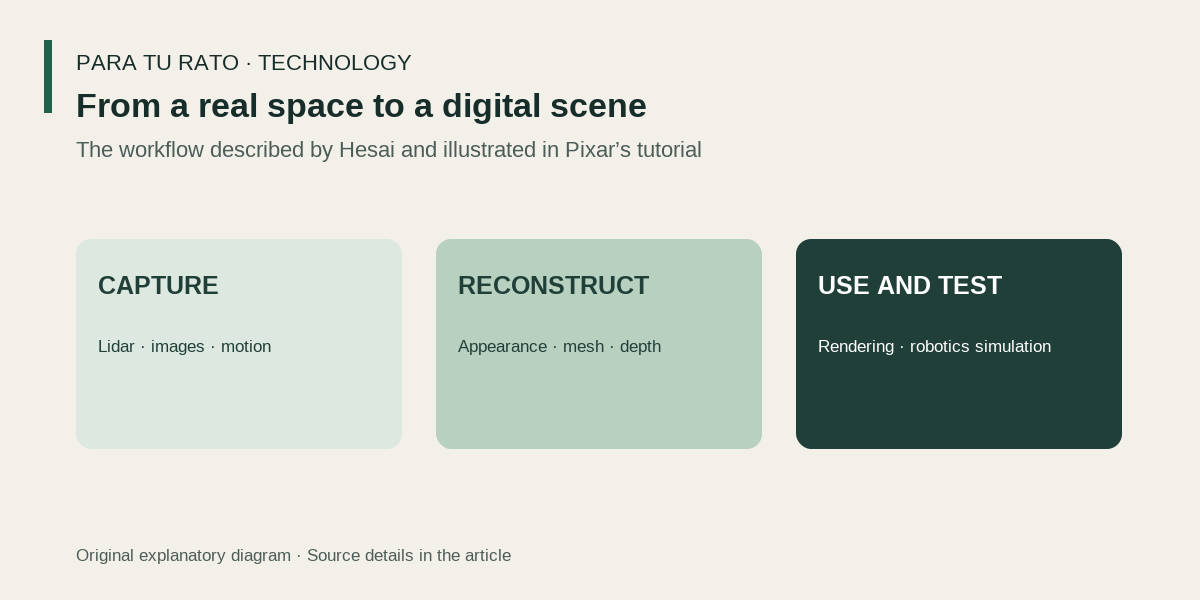
Kosmo integrates lidar, imaging, and motion measurement. According to Hesai, its platform produces visual representations, meshes, and depth data within a single reconstruction. Hesai also announced collaborations with Galbot and Dexmal for robotics applications.[1]
The product's contribution lies in bringing capture, processing, and working tools together into a single workflow. For a studio or a laboratory, the practical appeal is having a digital baseline of the location it wants to reproduce, without having to build every detail by hand.[2]
Pixar demonstrates a concrete application
A tutorial published by Pixar on October 5 provides a demonstration outside the launch announcement. The team captured an area of its campus with a Kosmo camera and brought the result into Houdini and RenderMan. The example makes it possible to modify the position, size, or transparency of elements in the scene and explore different visual treatments.[3]
That workflow still comes with caveats. The tutorial uses a beta version of RenderMan 28, which is scheduled for release this winter. Furthermore, the lighting and shadows in the example remain part of the original capture: the demonstration does not recalculate them. The result documents a specific creative use without by itself proving Kosmo's effectiveness for training robots.[3]
A good image is not enough to simulate reality
Hesai estimates that an operator can scan a typical 100-square-meter interior in about 15 minutes. That is a manufacturer estimate, subject to layout and capture requirements; it does not equate to the time needed to train and deploy a robot.[1]
There is a technical reason for this distinction: reconstructing the appearance of a space and reproducing its physical behavior are different problems. The original Gaussian Splatting study focuses on representing and rendering scenes. Its ability to generate convincing images does not prove that a simulation accurately describes how an object slides or what happens when a gripper holds it.[4]
Kosmo thus opens a path for reusing real locations in digital work. Its reach will depend on the task: in audiovisual creation, there is already a documented demonstration; in robotics, the decisive test will be verifying whether what machines learn in those scenarios improves their behavior when they return to the physical environment.[3][4]
Sources and checks
Company documentation details announcements and specifications, while reports, analyses, and user accounts provide external context. Multiple pages from one company do not represent independent verification, and external links do not constitute editorial endorsement.
- [1] Hesai — Building the Data Infrastructure for Physical AI: Hesai Launches Kosmo 3D World Data EngineOfficial source · Checked on 17 October 2026
- [2] Hesai — Kosmo en WAIC: antecedentes y calendario del lanzamientoDocumentation · Checked on 17 October 2026
- [3] Pixar RenderMan — Gaussian Splatting the Pixar CampusDocumentation · Checked on 17 October 2026
- [4] Kerbl y colaboradores — 3D Gaussian Splatting for Real-Time Radiance Field RenderingDocumentation · Checked on 17 October 2026